
Don't guess - test!
Training zones give us a way to organize easy, steady and hard work around your current fitness. The goal is to choose a useful training dose, then check how you respond.
Our at-home tests give you a practical starting point. The current cycling analyzer estimates VO₂max from power and models critical power and W′ from several efforts. It does not directly measure VO₂max, VLamax, lactate thresholds or your personal fuel use. Use the estimates alongside repeatable performance tests and how training feels. Laboratory testing can check specific assumptions when that information will help your plan.
We talked about testing in Know Your Limits - Testing & Planning.
Use your own test results alongside heart rate, effort and training history. Keep laboratory measurements separate from model estimates. A field estimate can help guide decisions without measuring every physiological marker.
Post test - Setting the zones
The test method matters. Lactate thresholds, ventilatory thresholds, FTP, critical power and maximal lactate steady state are related ideas, but they are not interchangeable labels. Use the definition and method that produced your result.
Fuel the work, including long easy rides. Carbohydrate needs depend on duration, intensity, what you ate before the session and what your gut tolerates. Practice a fueling plan rather than assuming an easy ride needs only a small amount.
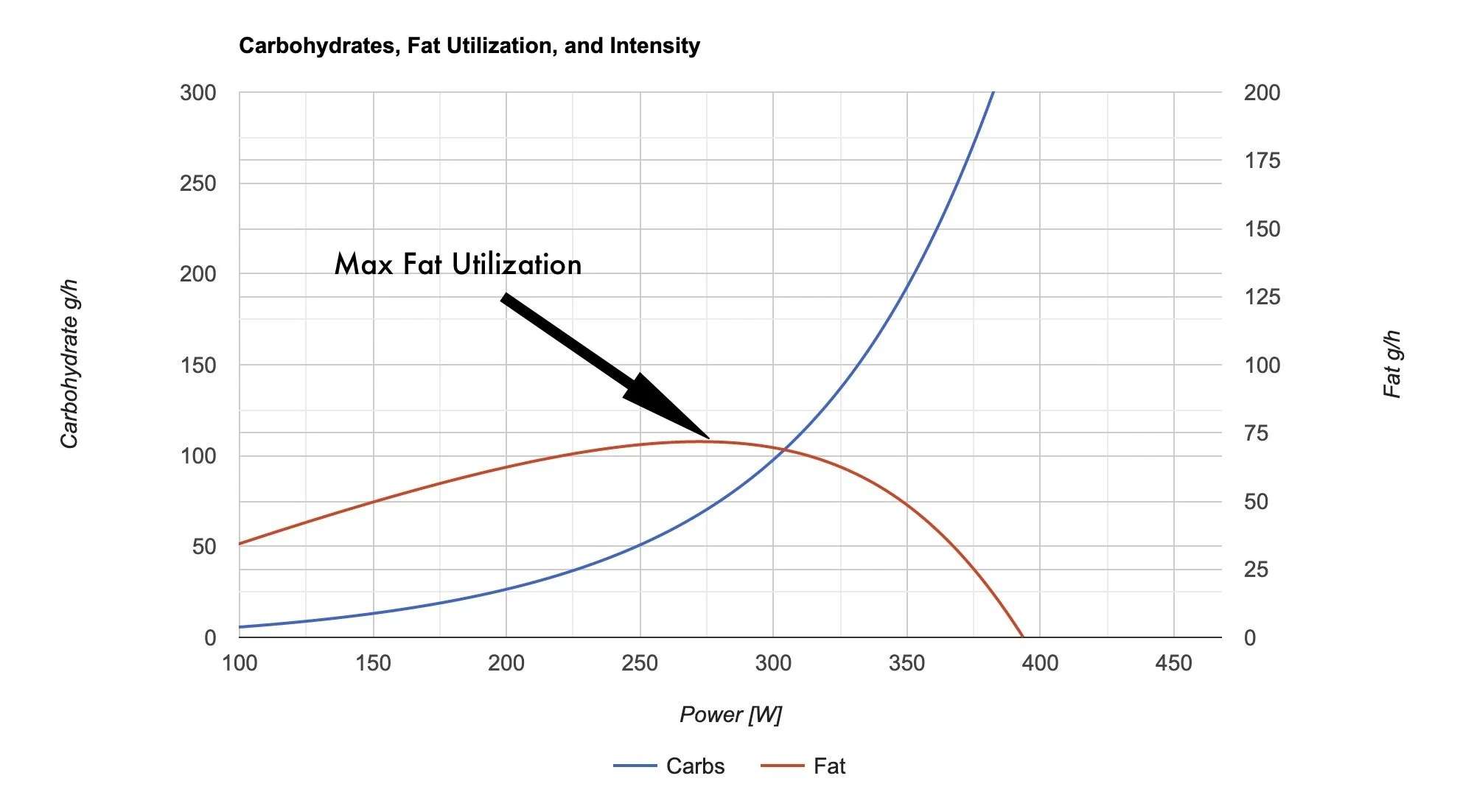
Original graphic retained for illustration. Its athlete, test protocol and model are unspecified, and the numerical curves have not been verified. Do not use the plotted values to set your training zones or fueling intake. Actual fuel use varies with the athlete, diet, exercise and testing conditions.
The first lactate or ventilatory threshold can help guide the upper end of easy training. Its exact value depends on the athlete and the testing method. Use your own results alongside heart rate, effort and the ability to speak comfortably. Breathing through your nose alone does not define a training zone, and the point of maximum fat use does not have to match this threshold.
Your energy systems work together. Both fat and carbohydrate contribute during endurance exercise, and carbohydrate can also be used aerobically. Lactate is continuously produced and used as fuel, even when oxygen is available. Its blood concentration reflects the balance between its appearance and removal. It cannot tell us your fat-burning rate on its own.
At higher intensities, lactate and breathing responses help us identify changes in exercise demand. The second threshold is a useful guide for hard, sustained work, but it is not a switch from aerobic to anaerobic exercise or proof that your muscles have run out of oxygen. Aerobic energy production remains important above it.
Use individual testing and repeatable training to guide hard work. Breathing and perceived effort provide useful context, but they do not make different threshold definitions identical.
Using this information to set individualized training zones
Okay now that we start to understand what's happening in our system we can put together our personal training zones. These will help us to improve our limiters. There are a lot of different training zones out there and every coach has their own little approach (Often because they have a certain kind of athlete they work with. I'm more endurance based therefore I focus on markers that will drive aerobic performance, metabolic efficiency and slow twitch fiber development. The good old triathlon, cycling and marathon stuff.)
Recovery: Very easy movement can be a comfortable way to finish a session. It can speed the fall in blood lactate, but this does not guarantee better adaptation or next-day recovery. Keep it easy, and rest when rest is what you need.
Easy Aerobic: Comfortable, repeatable work that builds aerobic endurance. Use individual markers and the talk test to keep the effort controlled. Both fat and carbohydrate contribute. Consistent endurance work supports the adaptations that help you sustain longer efforts.
Steady Aerobic: A controlled step above easy work when it fits the session and your current fitness. These sessions add useful work but also add fatigue. Judge the dose by the whole week and how you recover.
Sweet Spot: A practical label for sustained subthreshold work, not a separate physiological switch. Use the workload that fits your individual markers and the purpose of the session, and account for the fatigue it adds.
Threshold: Hard, controlled work around your individually assessed upper threshold. How long you can sustain it varies with the athlete, the test definition, conditions and fatigue. Use it to build sustained performance without treating a one-hour effort as a universal rule.
VO₂max: Hard intervals can improve aerobic capacity. Four- to six-minute efforts are one option, but shorter formats can work too. Choose duration, recovery and repetition count to create a useful stimulus you can recover from.
I hope this helps you to understand that training zones are not just some weird number but that they are based on your personal markers! Be smart!
https://www.konaendurance.com/
Flo
Explore Kona Endurance training plans and review each plan’s sample weeks and starting workload against your tested zones.
Want help applying this to your own training? Explore Kona Endurance coaching or email info@konaendurance.com to talk about your goals.